|
I spent five years writing Never Always, Never Never. During that time, I went quiet. No regular posts, no newsletter, no commentary on whatever the marketing industry was arguing about that week. The book consumed so much of my life. I was researching, rewriting, arguing with editors and cover artists, and stewing with ideas that I didn't feel right putting into the world until the full argument was there. Now it is. And I still have more to say. The book covers 33 concepts across marketing, AI, and strategy. Each one could fill a semester. What I published is the foundation, the baseline for how I think about all of it. But these fields move fast, and the examples keep multiplying. Every week I see a company proving one of these principles right, or spectacularly wrong, and I want a place to put those stories. That's what this is. Each week I'll take a concept from the book, bring in examples and context that didn't make the final cut, and show how these ideas are playing out right now. The book was meant to be a starting point. This is where the conversation continues. Let's start with one of my favorites. |
What Wilt Chamberlain and Marketers Have in Common
In 1962, Wilt Chamberlain scored 100 points in a single NBA game. That record still stands. But here's the part most people miss:
Wilt was famously terrible at free throws. On that night, he made 28 out of 32. An 87.5% success rate from a guy who usually shot around 40%. He shot them underhand. The "granny shot."
He'd been experimenting with it earlier in the season and watched his percentages climb. On the greatest night of his career, it worked better than ever. And then he stopped doing it. Permanently.
He admitted years later that he felt "silly, like a sissy" shooting that way. One of the greatest athletes in history found something that demonstrably made him better and walked away from it. Not because it stopped working. Not because he found something superior. Because it made him feel uncomfortable.
I call this the Wilt Chamberlain Effect. And once you see it, you can't unsee it.
It's the same instinct that keeps marketers from embracing the strategies and technologies that would fundamentally improve their businesses and careers. The data says move. The gut says stay.
Geckos, Bunnies, and Bears
There's an old saying in business: "Nobody ever got fired for choosing IBM." The safe choice. The one that looks serious. The one nobody questions even when it's not the best option.
That instinct explains one of the strangest patterns in marketing today. Decades of research prove that animal mascots and brand characters are among the most effective tools ever discovered for building the kind of recognition that drives long-term revenue. Some of the most iconic brands on the planet, companies that have survived wars and recessions and entire technological revolutions, use characters as a core asset.
And almost nobody launching a brand today does it.
System1, the UK-based analytics company named after Kahneman's "System 1" thinking, has tested tens of thousands of ads and found the same thing at scale. In one analysis of nearly 200 US TV spots, ads with animals consistently drove the highest levels of positive emotional response. Dogs in particular lit up the brain. EEG and eye-tracking studies showed emotional engagement spiked the moment a dog appeared, and dipped when it left the screen.
That emotional lift pays dividends in memory. System1's database shows that ads with characters, many of them animals, are dramatically more likely to be remembered. In character-led ads, 65-100% of viewers could correctly name the brand, compared to near-zero recall for some generic executions. The Aflac duck is the classic case. Before the duck debuted in 2000, U.S. name recognition for Aflac was under 10%. Within a few years, awareness was close to 90%, and sales had doubled.
The research is overwhelming. The results are public. And executives still won't do it. Because a sarcastic parrot or a cute puppy doesn't feel serious enough for their brand. It feels silly. Like a granny shot.
So they do the safe thing. The thing that looks professional. The thing nobody gets fired for. And then they get in their car that's insured by a gecko with a British accent, drive home to a house stocked with batteries sold to them by bunnies, toilet paper sold to them by animated bears, paper towels sold to them by a burly lumberjack, cleaning products sold to them by a smiling bald guy, and a pantry filled with products featuring characters of every kind.
The data is in their hands. They just won't shoot underhand.
Why I Put a Dog on My Book Cover
Here's the ultimate irony: I've read several marketing books that highlight this exact research and give the same advice I just gave you. And every single one of them has a cover that looks like a generic business book. Some abstract image of a funnel. A gradient. Maybe a bold sans-serif font.
That's the reason my book has a dog on the cover.
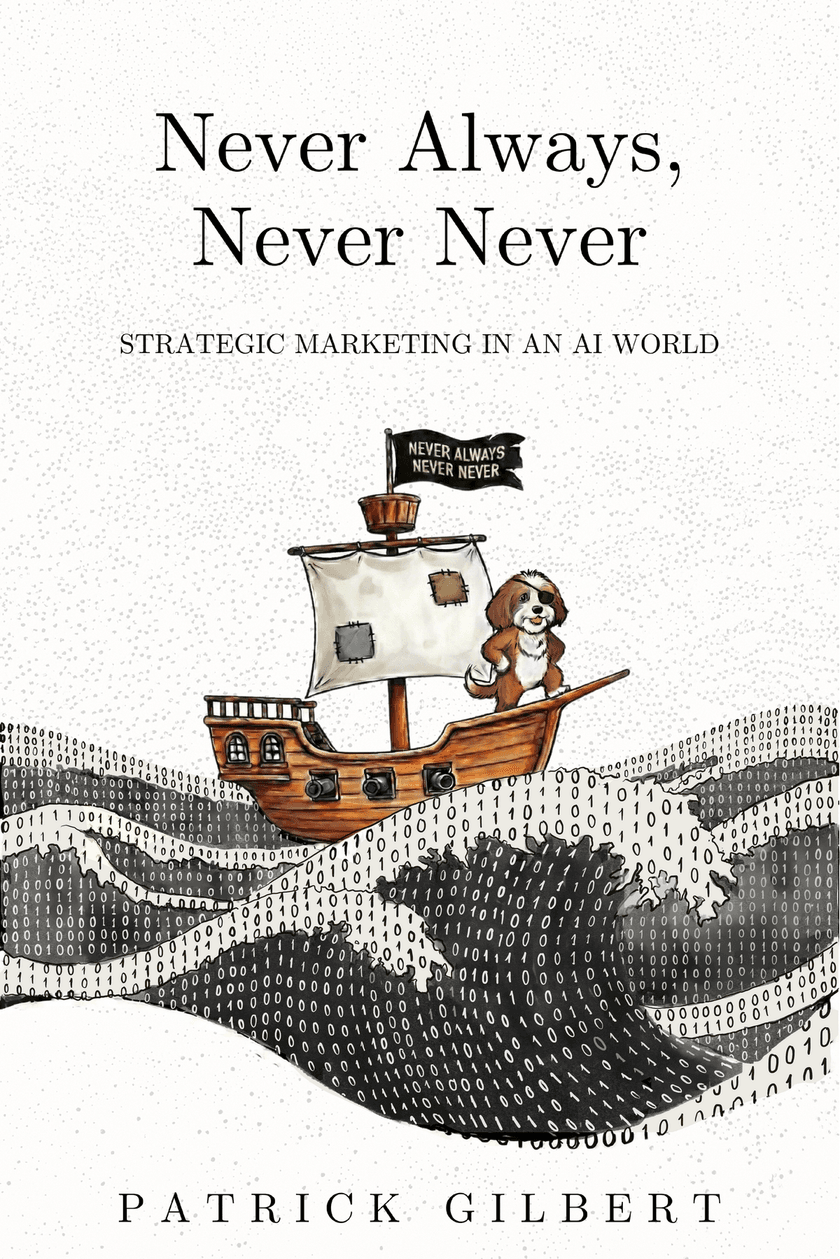
Before Never Always, Never Never was published, I showed the cover to people in my life and they looked at me like I had five heads. "Nobody is going to know what this book is about," they said. And sure, it's different. It has the risk of confusing some folks. But I believe in the data. I'm not afraid of looking silly because I ultimately care about selling as many books as possible. The research says characters work. The research says animals work. So I did the thing the research said to do, even when the people around me thought it was a strange choice.
Those criticisms were put to rest pretty quickly. Never Always, Never Never debuted as the #1 New Release on Amazon in Marketing, Advertising, E-Commerce, and Generative AI. Turns out the granny shot works for book covers too.
It would have been very easy to play it safe. To pick a cover that looked like every other business book on the shelf. Nobody would have questioned it. But "nobody would have questioned it" is exactly the problem. That's what Wilt did when he went back to shooting overhand. Nobody questioned it. And his free throw percentage dropped right back down.
The Takeaway
The Wilt Chamberlain Effect isn't about bad data or bad intentions. It's about the gap between knowing and doing. Airbnb proved this in 2021 when they cut their overall marketing budget by 28% and shifted spend away from performance ads (the pay-per-click, direct-response campaigns that most companies cling to during a recovery) and toward brand marketing (the long-term storytelling work that's harder to measure and easier to cut). Every instinct said spend more on search ads and chase bookings. Their competitors did exactly that: Vrbo increased performance ad spend 67%. But Airbnb grew while spending less on ads, because they were willing to invest in the thing that felt riskier and looked wrong on a quarterly spreadsheet.
Most people won't. Most companies won't. Not because the evidence isn't there, but because the right move often looks like the risky one. And the risky one requires you to be comfortable looking different while you wait for the results to prove you right.
And here's what makes this even more urgent. AI optimizes for the average. Large language models are trained on billions of data points, and what comes out the other side is, by definition, a consensus. The most probable next word. The most common pattern. The safest creative choice. When every brand runs the same prompts through the same tools, they all converge on the same ideas, the same look, the same strategy. In a world that's rapidly commoditizing around that consensus, being the contrarian isn't just a personality trait. It's a competitive advantage. The granny shot has never mattered more.
That's from Chapter 16 of the book. If this story resonated, there are 32 more like it.
Case in point: Domino's just introduced a puppet named Dom to their commercials. It's a strange execution, but someone inside that organization clearly understands that it's time to bring back the older principles of traditional marketing. The granny shot is making a comeback.
One more thing: if you purchased a copy of Never Always, Never Never, I would sincerely appreciate a 5-star review on Amazon. Every review makes a massive impact on the book's rankings and visibility. It takes two minutes and it helps more than you'd think.