I want you to picture a typical Harley-Davidson customer. What do they look like?
Actually, wait. I'll just ask Gemini:
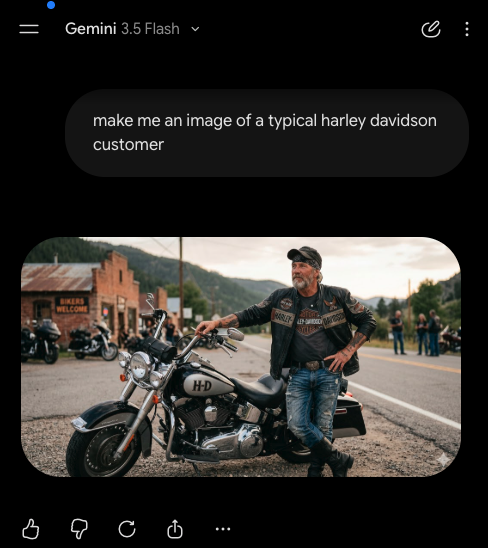
Does this fit your mental model?
Let me get a second opinion from ChatGPT:
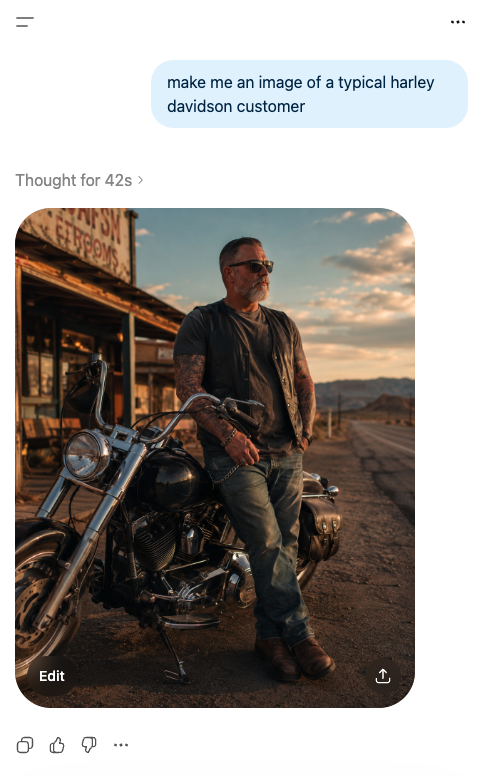
Hell yeah, brother.
You and I (and Gemini and ChatGPT) are likely on the same page. This, to me, is the Harley-Davidson customer.
But you'd be surprised to find that customers who fit this persona, a tattooed guy who drinks beer and thinks his Harley is a positive aspect of his visual identity, make up just 3.5% of Harley-Davidson's revenue. Most of Harley's business comes from casual riders who enjoy the product but don't look like this and don't make it a huge part of their personality.
Here's something else that might surprise you: more than half of Coca-Cola's customers only buy one or two cans each year.
Read that again. Yes, the majority of Coke customers buy only one or two cans per year.
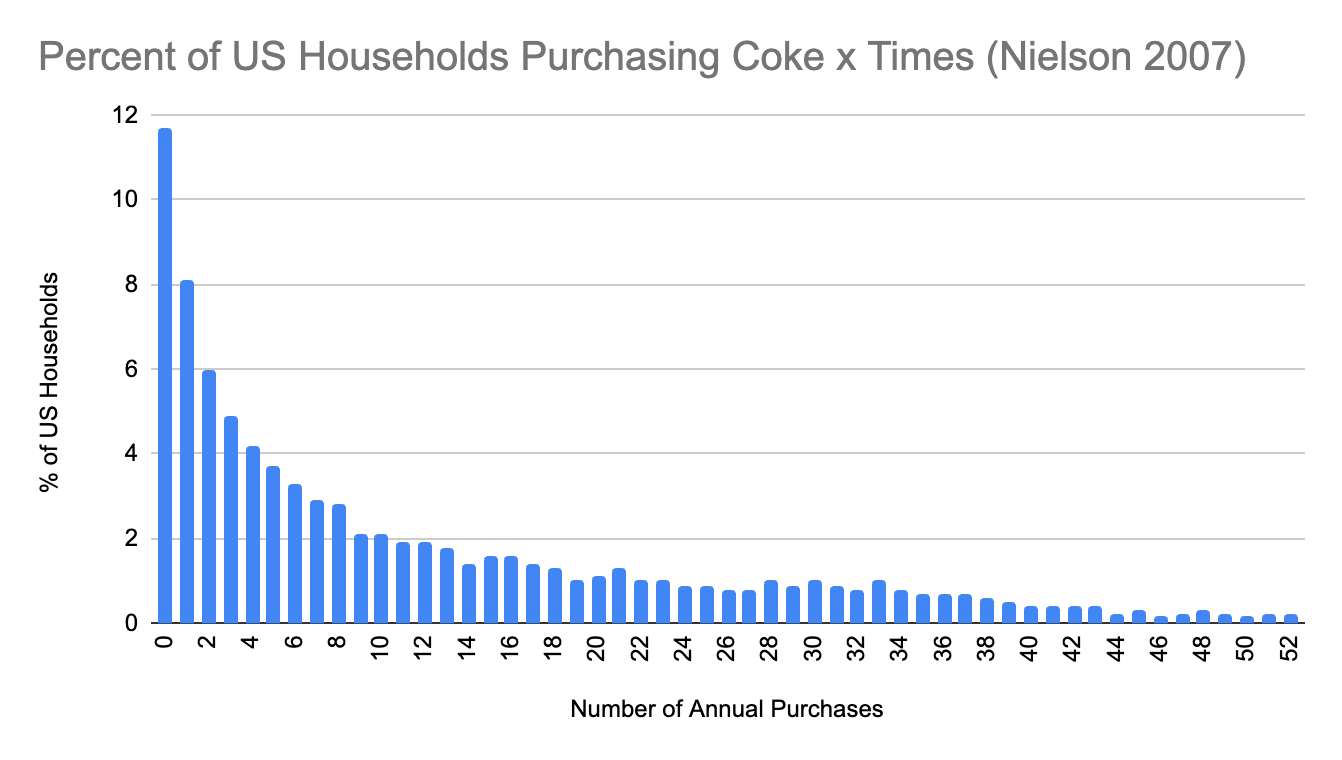
Research from Byron Sharp and the Ehrenberg-Bass Institute has documented two patterns worth noting:
- Most consumers of most brands are "light buyers" who buy infrequently.
- Brand loyalty is overblown. Few consumers are truly exclusive to one brand, and when they are loyal, it's mostly out of habit and convenience rather than emotional attachment.
This is true for brands where we assume the customers are fanatically loyal (Harley-Davidson, Coca-Cola, Apple), and even brands that are addictive by nature (Starbucks, DraftKings, Zyn).
If a brand like Harley-Davidson, with its seemingly fanatical fanbase, cannot bank on brand loyalty as a growth driver, then we all better get busy focusing on new customer acquisition. There is no other way.
And since most customers are light buyers who purchase infrequently, we need to ensure that we make it easy and convenient for customers to choose us.
These facts present a major challenge for most marketing briefs. Most "buyer persona" exercises focus on an idealistic version of the target audience. And while that can be helpful, the unintended consequence is often a marketing strategy that caters to the small percentage of the population who might be heavy, loyal buyers while alienating the light and occasional buyers who actually represent the largest ceiling of total revenue.
Let's look at this from a different angle. Imagine you're running a philanthropic event at your university, raising money for cancer research, and you need to recruit student volunteers.
Let's use Gemini to guide our marketing strategy:
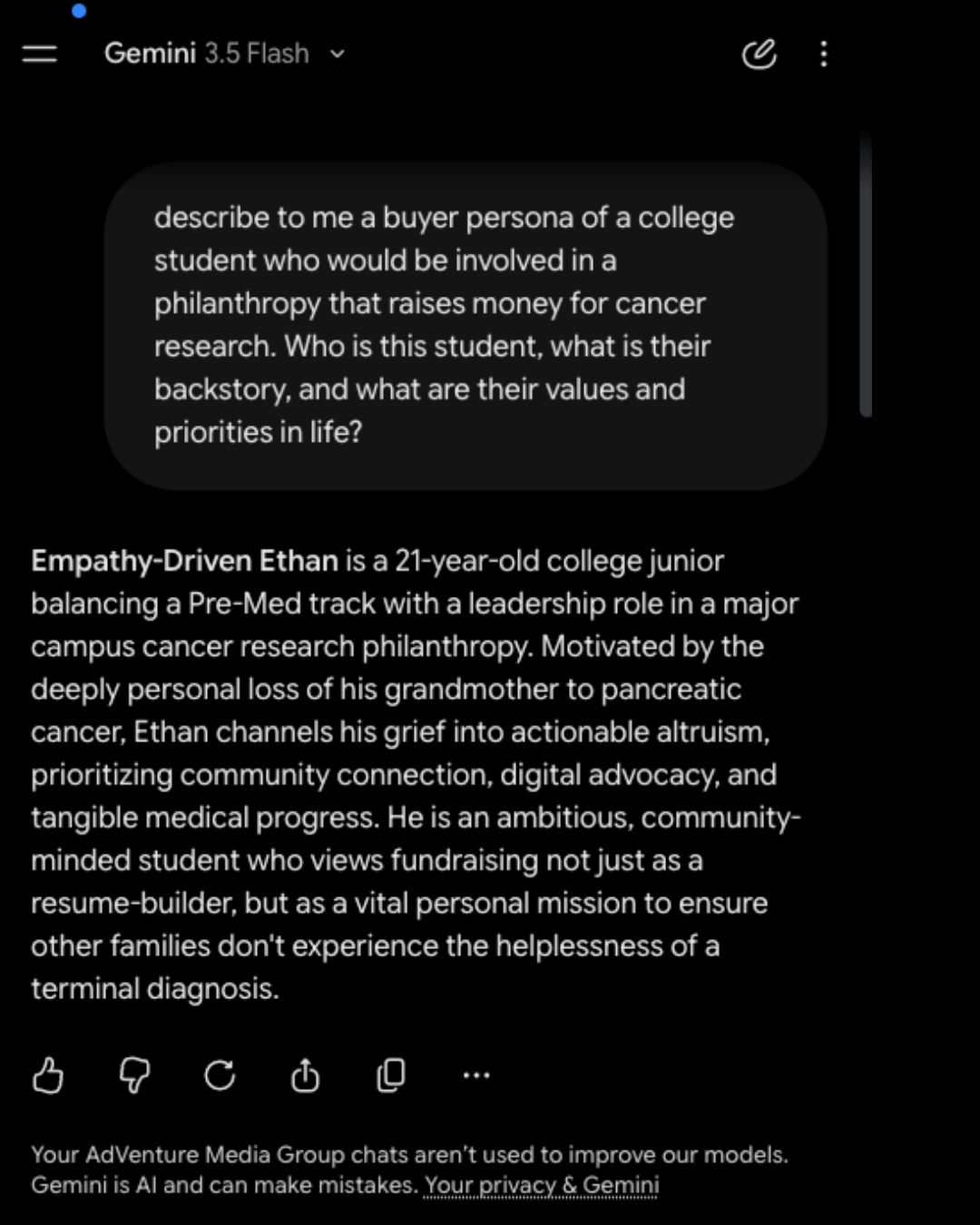
To summarize: a pre-med student with a deep personal connection to this cause. Ambitious, has his life together, probably empties the dryer lint after every cycle.
This seems great!
Let me tell you something: I was none of those things when I was in college. But I was involved in a very successful philanthropy. And while I certainly knew a few people who fit our fictional buyer persona, the majority of the volunteers (and therefore, donors) were people who looked a lot more like me than Empathy-Driven Ethan.
The Penn State Dance Marathon, known as THON, is a student-run philanthropy that raises money for childhood cancer care and research. The event itself is a 46-hour, no-sitting, no-sleeping marathon where ~700 students stand on their feet while 15,000 volunteers keep the operation running, raise money, and cheer on the dancers.
But the weekend is just the visible peak. THON runs year-round with committees for finance, PR, technology, marketing, vendor relationships with massive brands like Pepsi and Subway, and dozens of other functions. It's honestly not appropriate to think of this as a student organization: THON is a multi-million dollar nonprofit that happens to be entirely run by student volunteers.
This past February, THON raised $18.8 million. Lifetime total: over $254 million. It's the largest student-run philanthropy in the world, by a mile.
Why is it so successful?
Most charitable organizations grow by finding people like "Empathy-Driven Ethan," who already have a deep personal connection to their cause. When they've exhausted that small and finite pool, 100% of their marketing goes to trying to convince everyone else that their mission deserves support. They explain the hardships, the underfunding, the urgency, appealing to your rational brain and hoping a logical case will compel you to donate or volunteer. And that approach works to an extent, but it has a ceiling because you're only reaching people who already prioritize philanthropy. You're marketing to your heavy buyers.
At Penn State, THON is everywhere, all the time, and there are countless ways to become involved. You almost have to go out of your way to avoid it. There are 15 or more committees needing hundreds of volunteers each. But aside from that, every fraternity, sorority, sports team, and student organization participates in some capacity. You can get involved at whatever commitment level fits your life.
It's also cool to be involved with THON. I know I'll get some flak for saying this, but your THON involvement is a bit of a status symbol. The Committee Captains walk around campus in their THON quarter-zips with the same swagger of a star athlete in a letterman jacket. (Yes, I still have my quarter-zip neatly pressed in a closet, convinced it'll be a cherished heirloom one day. I also recognize how ridiculous this all sounds.)
My roommate Joe was on THON's Executive Committee my senior year. This was such a huge commitment that I didn't see him from August to March. Every waking minute outside of class was spent at the THON offices, often sleeping on couches in the student union because the 20-minute walk home wasn't worth the four hours of sleep he'd get anyway. But Joe was in the minority. Most THON volunteers were like my other roommate, Jachin: a student with a busy workload, involved in two or three other clubs, went to the gym, played rec sports, juggled internships, camped out for Penn State football games, and had different groups of friends. In the middle of all that, Jachin would participate in two or three THON fundraisers each year.
That was the norm. Most volunteers are "light" volunteers.
The irony is that, if you knew both Joe and Jachin, you'd know that one of them largely fits the criteria that described Empathy-Driven Ethan: the clean-cut engineering student who actually empties the dryer lint. The other ... well ... is my buddy Joe. We love them both.
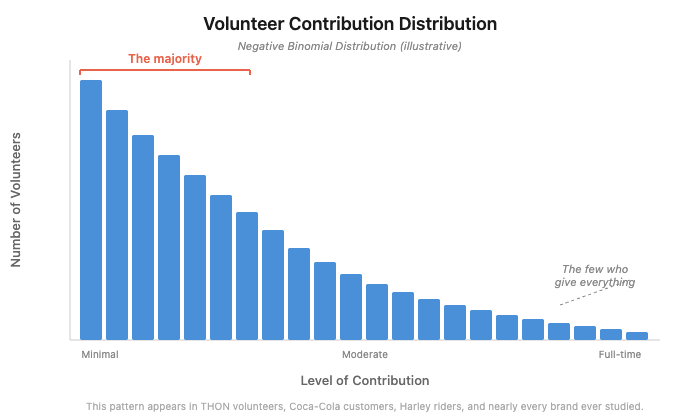
Most THON volunteers are not committing a full year of their life with this cause as the number one thing on their mind when they wake up in the morning. That's reserved for the longtail outliers on the far right of the curve (Joe, etc.). The majority look like Jachin: busy people who contribute a small amount because it's easy, it's fun, and it's part of what the campus does.
And those small contributions add up to millions of dollars in donations.
I grew up in New York and knew nothing about THON when I arrived at Penn State. I joined two clubs my freshman year: the Penn State Marketing Association and the Men's Club Lacrosse Team. Both organizations also participated in THON, even if in a small way.
More than 100 guys attempted to join the Club Lacrosse team each year, most of whom were about as talented (see: more talented) as I was. So when the team was looking for volunteers to spend a weekend canvassing for THON donations in the Pittsburgh area, I raised my hand, hoping to get more facetime with the team's leadership. At the end of the year, when they needed someone to take on the official title of "THON Chair" and lead the team's THON initiatives, I raised my hand again.
For my sophomore year, the new club president was trying to transform the lacrosse program from an unranked joke into a real competitive team, and we realized THON could build culture and team bonding that guys competing with each other on a field couldn't produce alone. My freshman year, the team raised $4,600 for THON. Sophomore year, $36,000. Junior year, $58,000. Senior year, $86,000.
And something else happened at the same time: we became one of the best club lacrosse teams in the nation. We won our first-ever national championship my senior year.
The program had completely turned around in three years, not because we recruited better players or worked harder, but because the culture of the program had completely changed. And as odd as this might sound, our team's commitment to not just lacrosse, but also being active THON participants was at the core of that culture change.
I owe so much to THON. Most importantly, it's how I met my wife. She played on the women's club lacrosse team, and we got to know each other through THON events.
This is what makes THON so interesting: I don't think of it as something I donated time and money to. I think of it as something that gave me so much. My spouse, best friends, leadership experience that far exceeded any class or internship, a national championship trophy, incredible memories, etc. etc. etc.
Wouldn't more charities benefit from embracing the idea that their supporters get something of real value in return for their contributions?
And yes, this is all in addition to the fact that the money THON raises makes a real impact for an incredible cause. Four Diamonds, the beneficiary of THON's fundraising, has helped ensure that 4,000+ families battling childhood cancer do not receive a single medical bill. They fund a staff of 30+ clinical oncology professionals, more than 80 researchers developing breakthrough treatments, as well as a Pediatric Neuro-oncology Program, a Pediatric Cancer Survivorship Program, a Stem Cell Transplant Program, an Experimental Therapeutics Program, and much more.
After graduating, I had the opportunity to move to Hershey, PA and work for Four Diamonds. I was able to see, firsthand, how the funds THON raised were being put to work, and I can tell you that it's exceptional.
So yes, it's an incredible cause, as many philanthropic initiatives are. But it blows my mind that we become uncomfortable with the idea that volunteers or donors get something out of the deal as well. We pretend like volunteering is only good if it's completely altruistic.
I think that's bad for marketing. Why can't more organizations be comfortable saying, "It's an incredible cause, also, it's a great place to meet people." Or: "It's an incredible cause, also, it'll look great on your resume." Or: "It's an incredible cause, also, you'll win more lacrosse games."
Why do we avoid talking about the truth?
By focusing your marketing on your idealistic heaviest buyers, you often alienate those light buyers who might think, "Wow! This is a great cause and I'd love to get involved, but I'm already so busy with school, building out my resume, trying to make new friends, and playing club lacrosse. Maybe I'll join a committee next year when things calm down a bit for me."
And obviously, we know how this ends: that person doesn't show up next year, and the organization's growth plateaus.
Let me give you a different example. U.S. consumers have had the option to buy electric cars for decades. The benefits have not been a secret. First and most important: it's good for the environment! But also, think of all the money you'll save on gas! Also, here are some tax benefits! Also, here are financing options that make electric cars extremely affordable!
The rational arguments always existed. Save the planet and save money. Those are two of the most rational benefits I've ever seen, shouldn't that be enough??
But nothing truly moved the needle. Until recently, you didn't know anybody who drove an electric vehicle, and if you did, they were probably weird.
Then something changed. Tesla came around and made it cool. At some point in the mid-2010s, owning a Tesla became a status symbol.
And also, you didn't have to deal with a car dealership. Tesla was the first brand to offer an e-commerce checkout experience where you buy online and the car is delivered to your home.
And also, Tesla worked with municipalities to secure preferred parking spaces in many public lots.
And also, the freaking thing drives itself.
And also, it's good for the environment and you no longer need to buy gasoline.
Wow! Let me get one of those immediately!
Tesla single-handedly changed the trajectory of the electric vehicle market, not because they attempted to explain the rational benefits of going electric, but because they built a cool brand that was easy and convenient to buy. And they reached astronomical heights by appealing to, and not alienating, the light buyers who make up the majority of the market.
This, my friends, is the icing on the cake. Gemini's response to this prompt was better than I could have hoped for. Show me a buyer persona for a 2026 Tesla customer!
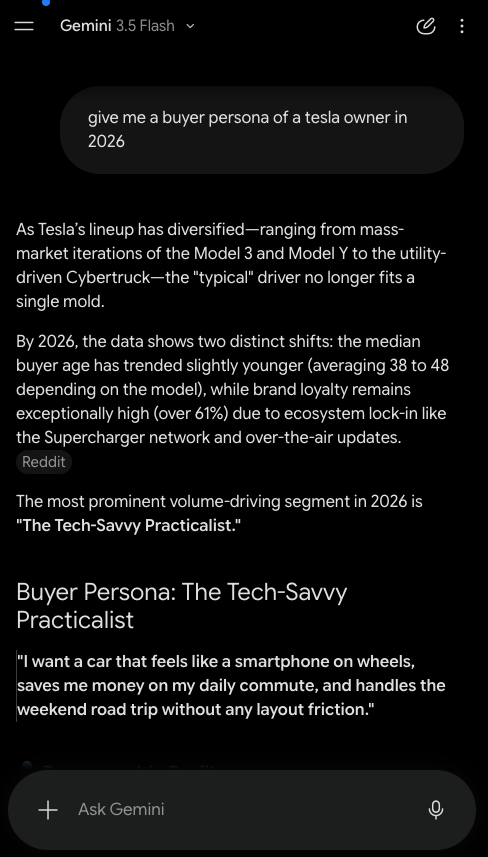
Go read that again. This is a long, long way from the stereotypical electric car customer from 15 years ago. Tesla's buyer persona in 2026 is "The Tech-Savvy Practicalist." A person who wants a smartphone on wheels. This doesn't mean they also aren't interested in doing their part for the environment; it's just a practical way to think about marketing strategy.
Too many organizations, nonprofits and businesses alike, design their strategy around the fanatic. They build buyer personas describing the most committed version of their customer and craft messaging squarely for that person. In doing so, they close the door on people who might have participated in a lighter way. Those people are not second-class participants. They are, by every measure we have, the engine behind every successful brand that's ever been studied.
THON works for the same reason the biggest brands in the world work. It's omnipresent on Penn State's campus: mental availability. And it offers a way for every student to participate at whatever level fits their life: physical availability. It doesn't just welcome the person who wants to make pediatric cancer research their life's work.
It recognizes that most students are busy juggling a million things and have a dozen priorities and goals they want to achieve throughout the school year. So THON finds a way to meet them where they are. And that's exactly what makes them so successful.
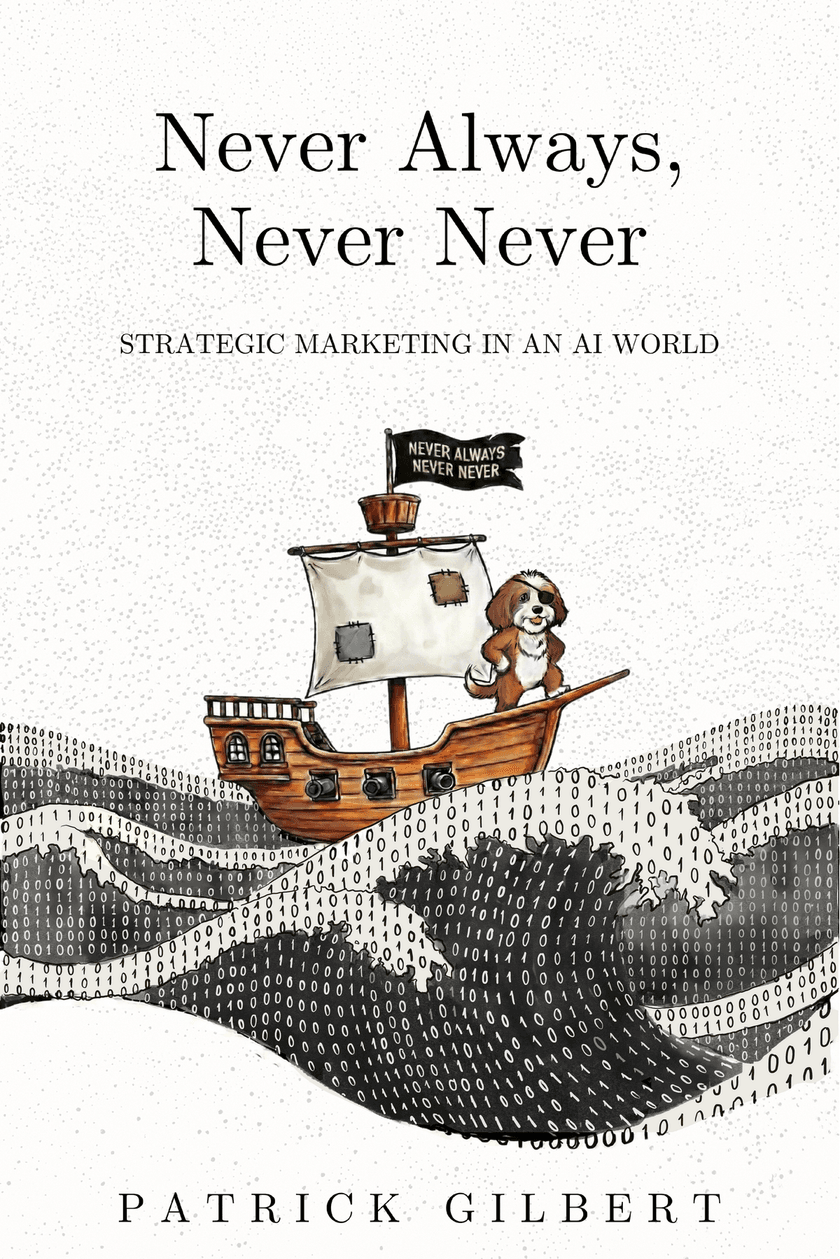
My book, Never Always, Never Never: Strategic Marketing in an AI World, came out on May 5th. Chapters 8 and 9 go much deeper into the light buyers principle. Mental availability and physical availability are covered in Chapters 10 and 11. If any of this shifted how you think about your own customers, the book goes deeper.