Mailchimp Built a B2B Brand That Did Not Sound Like B2B

Intuit paid approximately $12 billion for Mailchimp in 2021. For an email marketing platform serving small businesses, that number demands an explanation.
The product itself was not exotic. Email templates, contact lists, automation, campaign analytics. Dozens of competitors offered the same functional stack. Constant Contact, Campaign Monitor, ActiveCampaign, HubSpot, Klaviyo. The category looked interchangeable from the outside, and largely was.
What Mailchimp had that most of its competitors lacked was a brand. Not a logo and a color palette. A genuine, recognizable, culturally legible brand that made an otherwise forgettable product category feel human. That brand, built over two decades starting from a web-design shop in Atlanta in 2001, was a meaningful part of what Intuit acquired.
The company's story is a clean case study in distinctive brand assets and what they actually accomplish in a category where everyone claims to be different.
The Category Problem Mailchimp Refused to Accept
Email marketing software is a low-involvement category. Nobody wakes up excited to evaluate deliverability rates or segmentation logic. Small-business owners adopt tools like this because they have to, not because they love the product.
Jenni Romaniuk at the Ehrenberg-Bass Institute has shown that brands in categories like this rarely win through differentiation in the traditional sense. Consumers do not sit down and carefully compare competing platforms on feature matrices. They satisfice. They grab the tool that comes to mind first, the one a friend mentioned, the one that felt familiar when they went looking.
Byron Sharp's argument in How Brands Grow follows the same logic: most brands in a category are functional equivalents offering broadly similar products at broadly similar quality levels. What separates winning brands from losing ones is not superior features. It is mental availability. Being easier to notice, easier to remember, and easier to retrieve when a buying moment arrives.
Mailchimp understood this, perhaps intuitively. Rather than trying to win on features, it built a world around the product instead.
Freddie, the Name, and the Illustration System
The brand's distinctive assets were not accidents. Freddie the chimp mascot, the unusual name that stuck in memory precisely because it was slightly silly, the hand-drawn editorial illustration style, the informal tone that treated small-business owners as creative and ambitious rather than underserved and desperate. These were the memory hooks the brand built and repeated consistently across every surface.
That name alone was doing unusual work. In a category where competitors picked names like Constant Contact, Campaign Monitor, and ActiveCampaign, every word a corporate signal that this was serious software, Mailchimp sounded like something you would actually remember. And remembering is the whole game.
This is exactly the principle Patrick Gilbert covers in Never Always, Never Never. His chapter on distinctiveness cites Jenni Romaniuk's work on distinctive brand assets: colors, shapes, logos, characters, taglines that function as mental shortcuts. The goal is not to make consumers deeply passionate about your brand. The goal is to make the brand easier to notice, recall, and recognize in the moments that matter. The visual and verbal system was designed, consciously or not, to do exactly that.
Agency COLLINS documented its work on Mailchimp's brand system, describing the identity as part of the company's effort to distinguish itself in a crowded marketing-technology market. More expressive typography, custom illustration and animation, a flexible color system. The result was a visual language that worked across product interfaces, advertising, editorial content, and events, and that consistently pointed back to the same brand.
Consistency is what gives distinctive assets their power. Gilbert makes this point clearly: an asset only compounds when it is repeated over time, across channels, until it is burned into memory. Too many brands sabotage themselves by redesigning their identity every few years, blaming stagnation when the real problem is that they keep resetting the clock on assets that were just starting to work.
The Campaign That Made Mispronunciation Into Strategy
In 2017, Mailchimp launched one of the more unusual B2B campaigns in recent memory. Working with Droga5, the company leaned into the fact that its name was frequently mispronounced, a side effect of its high-profile podcast sponsorship of Serial, where the name became a cultural shorthand.
Most brands would have found this embarrassing. Mailchimp turned it into the creative platform.
Called "Did You Mean Mailchimp?", the campaign created a series of fictional adjacent brands built around the phonetic sound of the name: MailShrimp, MaleCrimp, FailChips, WhaleSynth, SnailPrimp. Each came with its own website, its own invented product, its own deadpan identity. The strategy was to make audiences curious enough to search for these strange names, discover the connection to Mailchimp, and share the work.
Nothing in that approach resembles standard B2B software advertising. There were no product screenshots, no automation workflow diagrams, no promises about deliverability rates or open-rate benchmarks. Leading with cultural curiosity and humor, the campaign created category entry points through memory structures built on entertainment rather than feature claims.
This is the distinction between differentiation and distinctiveness, and it matters. Differentiation asks consumers to process and compare product attributes. Distinctiveness works differently: it gives people easy cues to remember you by, not necessarily because you are the only brand with a certain feature, but because you have made something yours in memory. Les Binet has put it plainly: difference is less important than distinctiveness.
Reported reach was an estimated 334 million people, though that figure comes from third-party summaries rather than an audited primary source, so it should be held loosely. What is harder to dispute is the strategic logic: the campaign converted a potential liability into a recognizable brand moment, and it did so without saying a single word about email marketing.
Self-Service Distribution and What It Actually Unlocks
That brand did not operate in isolation from its distribution model. Both reinforced each other.
Freemium pricing lowered every adoption barrier. Users could start without a sales conversation, without a contract, without talking to anyone at all. Small businesses, freelancers, local retailers, and independent creators could adopt the product before they had formal marketing departments or dedicated budgets. As their contact lists grew, their paid plans grew with them.
This matters for brand-building because it aligned Mailchimp's identity with its actual customers. Rather than pretending to serve enterprise clients, the brand explicitly positioned itself as the tool for people trying to build something independently. The mascot, the illustration style, the tone, the content, all of it pointed at the same person: an entrepreneur who wanted capable marketing tools without enterprise-level complexity or cost.
That alignment between brand identity and physical availability is rarer than it should be. Many B2B brands build a visual identity and a tone that imply one kind of customer while their actual distribution model reaches a completely different one. The self-service model and the brand identity told the same story.
Expanding into editorial and entertainment content through Mailchimp Presents, the company produced films, podcasts, and stories about entrepreneurs and creative businesses. This extended the brand's positioning beyond the product itself. Mailchimp was not just a tool for sending emails. It was a brand associated with people building independent businesses. That is a meaningfully different category entry point, and a broader one.
We covered the broader relationship between inbound content strategy and brand-led growth in our analysis of HubSpot's shift away from its own inbound marketing playbook. The comparison is instructive: content can build an audience, but distinctive brand assets are what make a company memorable after exposure.
What "No One Cares About Your Brand" Actually Means for Mailchimp
One of the more counterintuitive arguments in Never Always, Never Never is that most consumers do not care about brands the way marketers want them to. They satisfice. They choose what is familiar, convenient, or top of mind. They are not forming emotional relationships with their email marketing software.
Mailchimp's success does not contradict this. It proves it.
Small-business owners were not passionate devotees of Mailchimp. Most were not thinking about the brand between sending campaigns. But when the moment came to choose an email marketing tool, Mailchimp was the name that surfaced. The mascot was familiar. The name was easy to recall. Compared to the alternatives, the tone felt less intimidating. That familiarity lowered the cognitive cost of choosing it.
Brain scan research cited in the book, from Michael Plassmann and colleagues, found that choosing a familiar brand produces measurably lower brain activity than choosing an unfamiliar one. Familiarity makes decisions easier. It is not that Mailchimp customers loved the brand. It is that choosing Mailchimp required less mental effort than evaluating five alternatives from scratch.
That is the real commercial value of brand salience. Not passion. Not loyalty in any deep sense. Just being the name that comes up first, the visual that feels familiar, the brand that is slightly easier to choose than everything else in the consideration set.
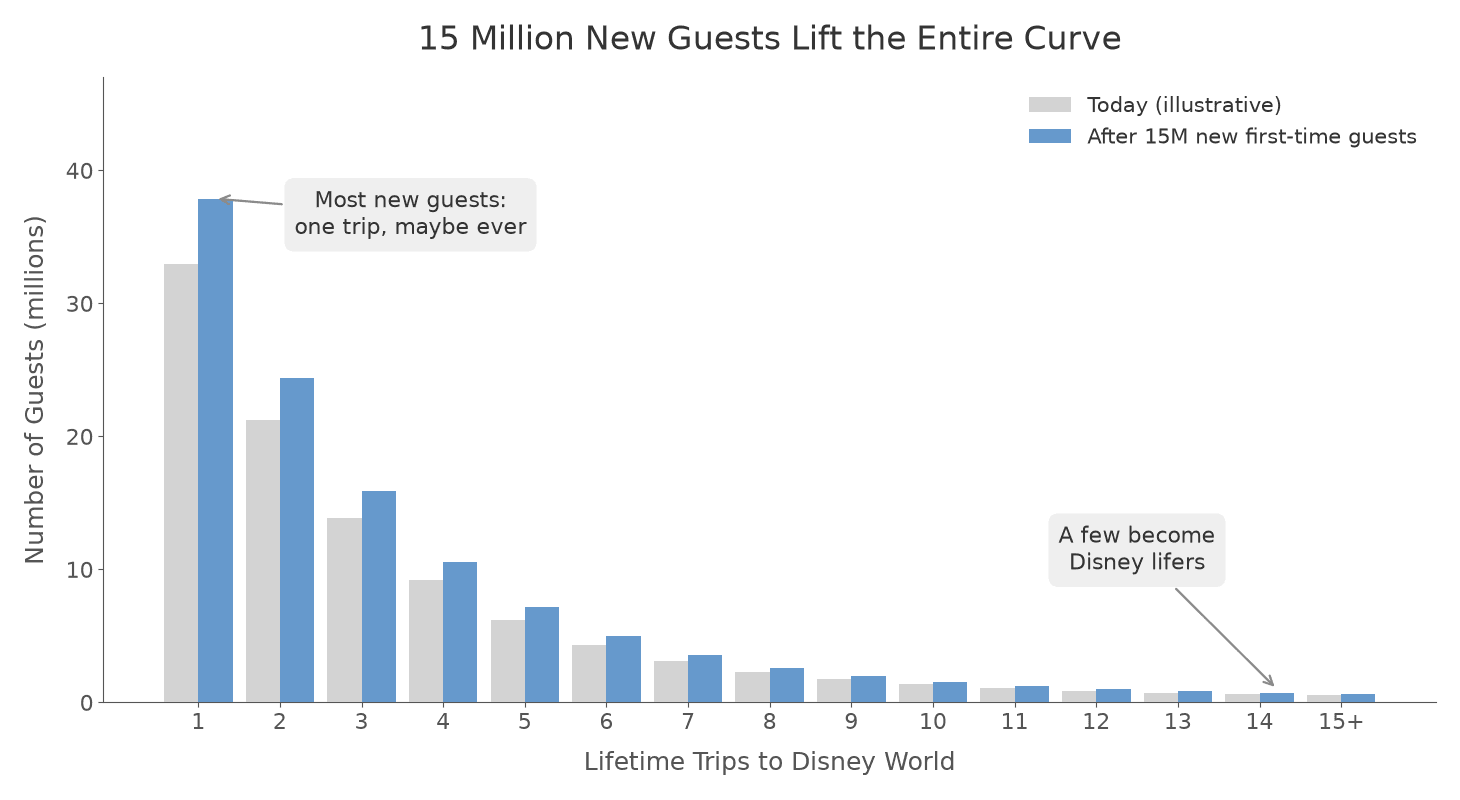
Growth followed the same pattern. Rather than converting a small number of loyal advocates into evangelists, the brand was built by being easy to choose for a large number of light buyers who needed email marketing tools and reached for the brand they recognized.
The $12 Billion Validation
By 2020, Mailchimp was generating approximately $800 million in revenue, up 20% year over year. Intuit announced the acquisition in September 2021 for approximately $12 billion in cash and stock, with the deal closing on November 1, 2021.
Intuit's stated rationale was to build an end-to-end growth platform for small and mid-market businesses, connecting marketing activity with accounting, payments, and customer data through products like QuickBooks. Mailchimp contributed $762 million to Intuit's fiscal 2022 results, though that figure covers only the portion of the year after the acquisition closed and cannot be read as a full standalone annual result.
That acquisition validates the commercial scale of what Mailchimp built. It does not prove the brand remained equally independent or effective after becoming part of a larger platform. What the transaction does confirm is that Intuit paid a substantial premium for both the technology and the brand's position in the small-business market. A generic email marketing platform with the same feature set but none of the brand recognition would not have commanded the same price.
That is the most honest way to read the $12 billion number. Part of it was technology. Part of it was the customer base and revenue. And part of it was the two decades of brand-building that made Mailchimp the name small-business owners reached for when they needed to send an email to their customers.
What B2B Brands Can Actually Learn Here
Here, the lesson is not that B2B brands should hire Droga5 and make strange fictional sub-brands. The lesson is structural.
In a category where products are functionally similar and purchase decisions happen quickly with limited attention, differentiation vs distinctiveness is not an abstract debate. It is the central strategic question. Trying to win by proving your product is marginally better than a competitor's is a losing battle in most B2B categories, because buyers rarely do the comparison carefully enough to notice.
Building distinctive assets, a name that is easy to recall, a mascot that surfaces the brand in memory, a visual system that is consistent enough to compound over years, creates a different kind of advantage. It makes choosing your brand require less effort than choosing anyone else's.
That is not a small thing. At AdVenture Media, the question of how clients build mental availability in crowded categories comes up constantly. Answers almost never start with features.
Mailchimp's figured this out early, in a category that gave them every reason to default to feature-driven positioning. They built a brand that did not sound like B2B, did not look like B2B, and did not behave like B2B. By the time Intuit came calling in 2021, that brand was worth $12 billion.
One takeaway is not complicated: in a low-involvement category, the brand that is easiest to remember when a buying moment arrives wins. Build the assets that make that happen, and then resist the urge to change them before they compound.
 Patrick Gilbert
 is the CEO of AdVenture Media and author of Never Always, Never Never and the bestselling Join or Die. He has been ranked among the top 5 PPC experts worldwide and has delivered keynotes at Google events across three continents.
More about Patrick →Enjoyed this?
Subscribe for more articles on strategy, AI, and what's actually working in marketing.
No spam. Unsubscribe anytime.